It’s déjà vu all over again
A couple of months ago I wrote a bit about iceberg A68 as what I called a “miniature of alarm.” To recap: iceberg A68 snapped off Larsen C in 2017 and slowly drifted north. By 2020 it was drifting towards South Georgia, which spawned stories like:
A68 iceberg heads towards South Georgia
An iceberg is heading towards the sub-Antarctic island of South Georgia. A68a – the size of the UK county of Somerset – broke off from the Larsen C ice shelf in 2017 and has been drifting north ever since. If it becomes grounded near the island, it could cause disruption to the local wildlife that forage in the food-rich ocean. Professor Geraint Tarling, an ecologist at British Antarctic Survey, says: “Ecosystems can and will bounce back of course, but there’s a danger here that if this iceberg gets stuck, it could be there for 10 years. An iceberg has massive implications for where land-based predators might be able to forage.”
BAS 4 November 2020
In reply to which I wrote:
The idea that A68 might end up stuck on South Georgia for ten years was very far fetched. In these pages I made the point … that South Georgia is at an equivalent latitude to Whitby. I did not make any comparisons between the life forms seen on the respective beaches of the two locations.
In comments under that post Dennis Ambler left this somewhat cryptic quote from a BAS press release, which I reproduce in its entirety:
Today 13 October 1998 the British Antarctic Survey received a satellite image showing an iceberg, approximately 150 km x 35 km, has broken off Ronne Ice Shelf, in the Weddell Sea, Antarctica (approx 77 S 50 W). In this region the front of the ice has now retreated to its 1947 position. The Ronne iceberg is four times the size of the last large iceberg to calve in the region which came from Larsen Ice Shelf. Dr Doake said “Regular calving of large ice bergs is a natural part of the life-cycle of an ice shelf. We have been expecting this event for some time…. Although ice shelves are retreating on the Antarctic Peninsula as a result of regional warming, we do not believe that this event is associated with climate change.”
The date was 19 years before A68 broke free and 22 before it became the iceberg of doom.
What Dennis had remembered but I had not was what became of the earlier iceberg of doom, A38. It took five years for A38 to drift north and reach the position A68 had when all the alarm bells started ringing in 2020. And what it was later feared A68 would do A38 actually did. On Christmas Day 2003, A38 grounded in the shallows by South Georgia:
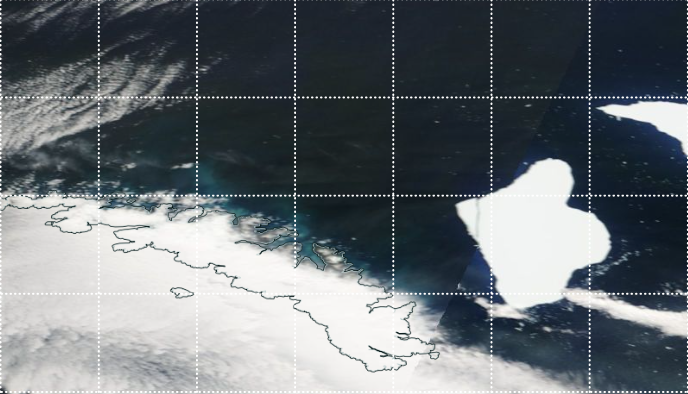
Here are a couple of snaps from space showing what happened next.


A38 survived for the southern winter, but in all hung about for less than ten months. Not ten years: ten months. As to its impact on wildlife, I’m not sure. Wiki says this:
Iceberg A-38B remained grounded for some months, affecting the foraging routes of adult seals and penguins, resulting in the death of young penguins and seals on the beaches of South Georgia.[7]
Wiki
The link [7] takes you to the BBC, in a story about the panic around A68, wherein it is written:
When the colossus A38 grounded at South Georgia in 2004, countless dead penguin chicks and seal pups were found on local beaches.
It would take a more dedicated search to find actual data on such matters, if there are any. To judge by the fact that the link used at Wiki was to a BBC story published 16 years later, perhaps there are no such data.
The point of all this is that a recent analogue of A68 (A38 was in fact larger when it broke free: 2750 square miles vs 2200) actually did what it was feared A68 would do. It grounded in the shallows at South Georgia. But it did not get stuck for a decade: it got stuck for one winter, less than ten months in all. Now, it is excusable for an amateur like YT to be unaware of this or to have forgotten it. Not so a professional, who should have known very well the history, if prepared to go on the record with what seemed an obvious exaggeration of the threat of the next giant iceberg to drift towards South Georgia.
End Note
Readers will be pleased to know that I probably have at most one more iceberg story in me.
Featured Image
A miniature iceberg in a shot glass of rather boring tap water.


This is South Georgia, an isolated island in the South Atlantic Ocean on the margin of the Southern Ocean. To the best of my knowledge there are no land-based predators here. There are of course marine-based predators, both mammalian seals and also avian albatross and penguins but their “land-based” status is not critical to their ecological role. The fact that they haul out on beaches or nest on land does not make these animals a “land-based predator”. This concept of land-based predators in South Georgia is pure obfuscation.
LikeLiked by 2 people
Aphids seem to loom large in your post pic – are they destroying the ice like they do my roses ?
LikeLike
Jit, I have experienced sock-removing, potentially iceberg protecting, cold weather at Whitby but that delightful town does benefit from the remnants of the Gulf Stream. So land-based, two and four-legged predators (of ice creams) are quite safe.
LikeLike
I haven’t been to the penguin colonies in South Georgia, but I have been to the Adelie ones in the Ross Sea. The beaches are littered with the carcases of dead penguins, especially young birds. Mortality figures aren’t known, but at the colony we visited, I would say only 40% of the eggs got through to being able to leave the beach. Then many of those would die first winter. I can’t imagine things would be so different on the other side of the continent.
We also found dead Weddell seal pups on the beaches. I suspect the killer whales who feast on the birds and seals are a major cause of the abandoned young. A lot more than an iceberg way off the coast would be. But don’t let facts spoil the narrative
LikeLiked by 1 person
Philip, the good professor ought to have been more precise. He could have said “marine predators that breed on land” or similar. I think his comment about the berg hanging about for a decade is more worthy of criticism.
Dougie, the presence of the aphid books is a coincidence. I was hurrying to catch the light. One of my own books is just off shot as WordPress clipped the image, and was rather blurred as it stood. Immediately above that was my favourite ratchet screwdriver, which I had just used to take the back off a spare PC to see if its power supply was molex. (It whistles.) As to the aphids on rose, you would probably readily believe that this is a topic I have been asked about a lot over the years. My stock reply is to tell the worried gardener to leave them be. Of the two main species of aphid on rose, one does this extraordinary thing that not many people know about, which is that it host alternates from its spring host (on woody plants) to an unrelated summer host (grasses or herbs). So, if it’s that kind, the aphids will clear off as soon as the first flush of growth by the roses slows down. The other kind hangs about all year, but colonies will sooner or later collapse owing to natural enemies.*
Alan, I guess I was being a bit flippant in my comparison. South Georgia is undoubtedly colder than Whitby. I was thinking of insolation. But South Georgia is probably more cloudy. But still.
Chris, one supposes that the absence of “land-based” predators means that carcasses survive for a long time and become mummified. Is this your experience, or were they fresh?
==
*There are plenty of other species of aphid on rose, but I am trying to simplify things.
LikeLike
Commonly something mentioned here stirs the thought that I don’t know much about that topic and my friend Wiki comes to my rescue. Today it was aphids, which I haven’t thought much about (except very bad ones whilst tending my gardens) since I was a small boy who looked at an aphid’s horrendous mouthparts through a lens and was utterly repelled. My friend Wiki informed me that many aphids are an ultra-feminist’s wet dream – they give birth to female nymphs that may already be pregnant, so short-circuiting males entirely. I hate them even more now.
LikeLike
What’s with all of this aphidophobia? The gardener should welcome the aphid because it eats ladybirds.
No, wait…
As you were. Death to all aphids!
LikeLike
Actually, Jit, I do take your point. There are good aphids and bad aphids and we should not tar them all with the same brush. I just wish the good aphids would do more to denounce the bad ones.
LikeLiked by 1 person
Aphids do not merely kill plants. Last summer there was quite an infestation on our apple tree. But the honeydew the aphids produced was also appreciated by bumblebees, which used it for fuel to keep going with their actual work of collecting pollen:

LikeLike
sorry to derail your post with “Aphids” – but as usual got some tips, may not spray this year 🙂
you say “Readers will be pleased to know that I probably have at most one more iceberg story in me”
sounds like your at deaths door – I think you will have many more iceberg tales to tell 🙂
LikeLike
Dougie, I only meant that giant icebergs are a niche interest, not that I wasn’t going to survive long enough to do two more!
Good luck with the aphids. The only kind I know for sure you should not ignore are American lupin aphids.
LikeLike
Jit, thanks as always. Isn’t it odd how little reporters in the mainstream media know about the subjects on which they opine so confidently?
LikeLike
Jit, here’s another one for you:
“Satellite data shows entire Conger ice shelf has collapsed in Antarctica
Nasa scientist says complete collapse of ice shelf as big as Rome during unusually high temperatures is ‘sign of what might be coming’”
https://www.theguardian.com/world/2022/mar/25/satellite-data-shows-entire-conger-ice-shelf-has-collapsed-in-antarctica
LikeLike
“Antarctic: Giant iceberg breaks away in front of UK station”
https://www.bbc.co.uk/news/science-environment-60825387
I confidently expected this to be followed by yet another litany of climate change laments. However, I was wrong, to my pleasant surprise:
LikeLike
There’s another Iceberg of Doom (this one has been labelled A81) now making headlines at the BBC:
Scientists track iceberg the size of London
https://www.bbc.co.uk/news/science-environment-64919341
I did like this bit:
LikeLike
“A23a: World’s biggest iceberg on the move after 30 years”
https://www.bbc.co.uk/news/science-environment-67507558
The article ends with a surprisingly positive statement:
LikeLike
“World’s biggest iceberg spins in ocean trap”
https://www.bbc.co.uk/news/articles/cd168081wxvo
Something remarkable has happened to A23a, the world’s biggest iceberg.
For months now it has been spinning on the spot just north of Antarctica when really it should be racing along with Earth’s most powerful ocean current.
Scientists say the frozen block, which is more than twice the size of Greater London, has been captured on top of a huge rotating cylinder of water.
It’s a phenomenon oceanographers call a Taylor Column – and it’s possible A23a might not escape its jailer for years.…
LikeLiked by 1 person
Mark – never heard of “Taylor Column” before, my 1st thought was it was A North Atlantic Ocean Gyre.
LikeLike
Wikipedia has a good (and mathematical) explanation of Taylor columns for everyone’s needs.
LikeLiked by 1 person
dfhunter, every day’s a school day! 🙂
LikeLike
Yip – you live & learn, that’s why I love this site, a wide range of knowledge from posters & comments, without the rancour some sites have.
ps – Alan, thanks for the pointer.
LikeLiked by 1 person
pps – Oops – just noticed I said “North Atlantic Ocean Gyre”, should be Southern, but wrong anyway.
LikeLike
After pointer from Alan – (PDF) Circulation, retention, and mixing of waters within the Weddell-Scotia Confluence, Southern Ocean: The role of stratified Taylor columns (researchgate.net)
Partial quote From – Conclusions
“We have demonstrated that the rugged topography that typifies the edges of the Scotia Sea, combined with the characteristic stratification and circulation of the regional flows, yield circumstances that are often conducive to the formation of stratified Taylor columns. The impact of these columns on the regional flows is notable: for example, the circulation above Discovery Bank on the South Scotia Ridge was seen to retain an intermediate-level float for close to 4 years, and to effect isopycnal mixing at a significant rate (order of 1000 m2/s or more). A concept emerges of Taylor columns on the southern edge of the Scotia Sea being slow, steady blenders, and acting to retain the waters in the vicinity of the WSC for lengthy periods, during which they can be subject to significant modification”
How It can retain “the frozen block, which is more than twice the size of Greater London, has been captured on top of a huge rotating cylinder of water.” is fascinating.
LikeLike
“Giant iceberg on crash course with island – penguins and seals in danger”
https://www.bbc.co.uk/news/articles/cd64vvg4z6go
The world’s largest iceberg is on a collision course with a remote British island, potentially putting penguins and seals in danger.
The iceberg is spinning northwards from Antarctica towards South Georgia, a rugged British territory and wildlife haven, where it could ground and smash into pieces. It is currently 173 miles (280km) away.
Countless birds and seals died on South Georgia’s icy coves and beaches when past giant icebergs stopped them feeding….
But some good could yet come of it:
…”This isn’t just water like we drink. It’s full of nutrients and chemicals, as well as tiny animals like phytoplankton frozen inside,” Ms Taylor says.
As it melts, the iceberg releases those elements into the water, changing the physics and chemistry of the ocean.
That could store more carbon deep in the ocean, as the particles sink from the surface. That would naturally lock away some of the planet’s carbon dioxide emissions that contribute to climate change...
Because, as we know, no BBC article is climate without a reference to climate change.
LikeLike
Thank you Mark. The clueless reporters are on the case once again.
I’m sure.
LikeLike
From: “Giant iceberg on crash course with island – penguins and seals in danger”
To:
We might add that sceptics were sceptical, as they are wont to be.
BBC link.
One of these days, I’ll write a note about that 2004 iceberg.
LikeLiked by 2 people
The BAS has an update on Iceberg A23a – grounded 70+ km from S. Georgia. No danger to wildlife and likely to enhance food stocks. WordPress won’t let me post a link.
LikeLike